I had just begun my semester abroad in London a week earlier. I was excited to be in a new city, making new international friends and interning for the BBC. On September 11th, at around 2pm, as our class began our teacher announced to us that a plane had hit the World Trade Center. We were surprised, thinking that it was a horrible accident but decided to continue on with our lesson.
When class finished, the secretary at the entrance to the building had breaking-news photos on her computer screen. “A second plane hit the other tower,” she said. My heart beating, I ran home turning on the television unable to believe what had happened.
A few days later I wrote in my journal:
The world has changed, it will never be the same again. I can not go back to New York and be the same. I cannot go back and live the same life I did… …I have always wanted to change the world. I want to make films that ask people to examine their lives, ask them if they are really doing what they want, if they are living their dreams. My life seems so trivial. It’s like what can I do? How can I keep on doing the same things that I’ve always done?
It has now been five years since that event. After returning to New York, I kept on asking myself, What can I do? what can I do? When I look back on that day, I realized how much it not only changed the world but change me as well. I wouldn’t be who I am today, someone committed to creating peace in the world.
I just recently discovered that on September 11th, 1906, Gandhi began the Satyagraha non-violent movement. So as we remember the 5th anniversary of the terrorist attacks, we can also commemorate one of the greatest achievements of the world-- the power of his movement to change the world and the hearts of man through non-violent direct action. Perhaps as he made his commitment 100 years ago, we can make our own commitment to ourselves today.
So what is my dream for September 11th? It’s my dream that it becomes a day of peace. So as we remember the tragedy of five years ago and say prayers for the lives lost, we can also see it as a call for peace. Not a call for war. Not call for revenge, but a call of people from around the world for peace.
Each of us can contribute to peace today and every day. Pray for peace, meditate for peace, talk about peace, join a peace activism group, or watch the film Gandhi.
Gandhi probably had little idea of how far his satyagraha movement would go, so you never know how far the commitment we make to peace will go either.
Sunday, September 10, 2006
My dream for September 11th

Tuesday, September 05, 2006
Walking for Peace from Kobe to Hiroshima
Hey, I copied this verbatim from what I wrote for the Peace Boat website about the walk I participated in August. It's already September, craziness! September is a very special month for Peace and I'll be updating my blog frequently over the next thirty days.
okay here goes:
On July 16th, the remaining participants of the 53rd voyage disembarked from the TSS Topaz at the Port of Kobe. Having sailed around the world for the past 102 days, their bags overflowed with gifts from unusual places and their digital cameras were jammed with the photos of their new international friends. The voyage took them to places previously unheard of and exposed them to diverse cultures, languages and global issues. While many of them were ready to return to their familiar lives and begin to look for work, a handful of them were ready to take the tools and skills they had acquired and put them into action.
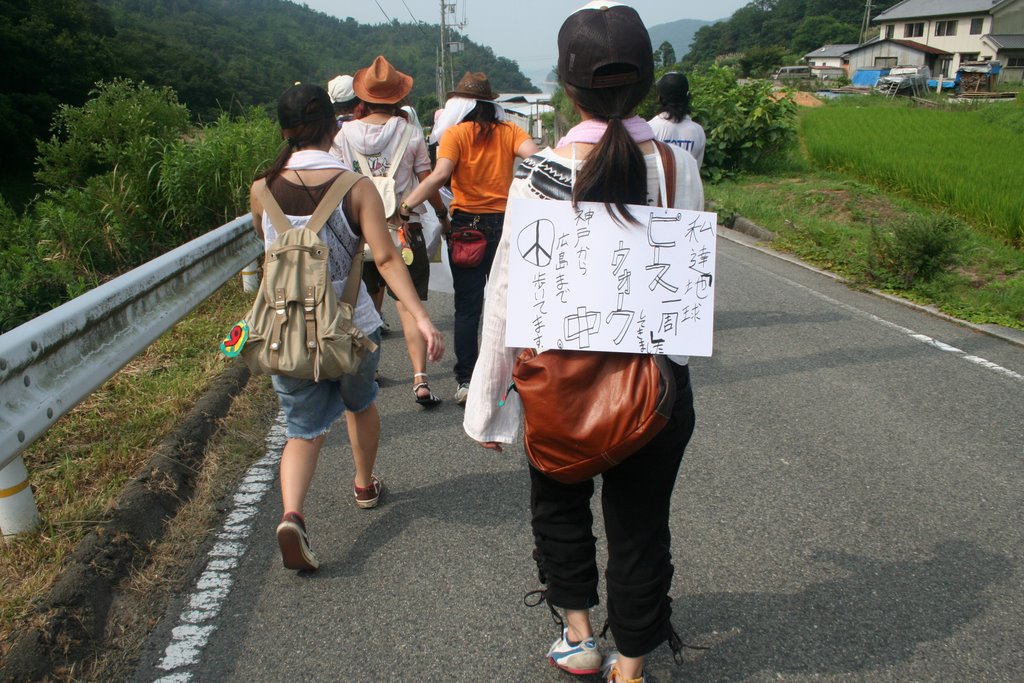
A week later, six eager souls began a 320 km peace walk from Kobe to Hiroshima. Beginning their walk from the Port of Kobe as the 54th Global Voyage departed, they aimed to arrive to the Hiroshima Atomic Bomb Dome by August 5th, one day before the 61st anniversary of the Atomic Bomb dropping. Miki Tatsuya, from Yokohama, joined the walk because he not only saw the walk as overcoming a personal challenge but also because, “I thought that if people could see us persevering in the heat of the summer, the message would reach their hearts that much more.”
Peace walk leader Shunsuke Hirai from Osaka, who began organizing the walk a week before Peace Boat arrived back in Japan, said, “we learned about so many issues while at sea. I asked myself what will I do with what I learned when I get back to Japan?”
The photo exhibit of the Depleted Uranium victims in Iraq.
Six walkers began the 15 day journey, averaging 25 kilometers a day under grueling temperatures of up to 35° Celsius. The walkers carried with them gruesome poster images of the Nagasaki and Hiroshima hibakusha. They also brought along photos of Depleted Uranium victims in Iraq taken by photojournalist Naomi Toyoda. Ji Hae Song, from Korea, said, “On the ship, we learned that there are many other “hibakusha,” not just the victims of Hiroshima and Nagasaki. People in Korea, Iraq and elsewhere are suffering from the effects of radiation.” The participants have helped the public to make the connection, by setting up photo exhibitions at heavily trafficked train stations and shopping areas.
Walking through the city of Hiroshima escorted by the police.
The walkers have not only been speaking publicly about their experiences around the world but have made stops along their journey to learn about Japan’s imperialist military past. They visited the island of Okunojima, also called Doku Gas Jima (Poisonous Gas Island) that defied the 1925 Geneva Protocol to produce mustard seed gas from the 20s through 40s. At the Poisonous Gas Museum, they learned that to keep the gas production a secret, the island was erased from many maps at the time. Now, the island that has been converted into a resort. “The kids were swimming in the pools... they said they changed the soil but you have to wonder…” said Yuka Asada from Akashi.
The walkers pose in front of the A-bomb Dome.
As they got closer to their destination, more and more participants joined the walk. At local convenience stores and restaurants, words of encouragement came from the local community. “Keep on trucking along,” “Wow, you’ve walked all that?” have been a few of people’s reactions. Shunsuke said that an older man he met at a bath house reminded him that the hibakusha had walked the same route fleeing the bombing in much more dire conditions—higher temperatures and without water. “We should remember this as we walk,” he told the group in one of their nightly meetings.
On August 5th, 30 participants completed the last leg of the walk to the Atomic Bomb Dome. They carried the 13m banner “Pieces of Peace,” made out of messages of peace they collected from around the world. Along with it they carried a banner they had received from the World Peace Forum in Vancouver in late June. As they walked through the city streets of Hiroshima, escorted by police, Shunsuke and Peace Boat staff member Mika Hasegawa loudly announced on a megaphone, “We have just traveled around the world. We want a world without war and so we support Article 9 of the constitution. We hope that Article 9 will be adopted by constitutions of the world.” When they arrived at the Atomic Bomb Dome in the Peace Park, the six original walkers delivered the banners to the Peace Promotion Office at the Hiroshima Peace Culture Foundation. A 15 day, 320km journey through both city and country had come to an end. That evening, they celebrated with other peace activists from Japan anticipating the memorial event the following day.
The “die-in” held at 8:15 on August 6th.
While many thousands gathered in the Peace Park for the main memorial event, many of the peace walk participants choose to participate in an alternative event by the Atomic Bomb Dome. At 8:15 am, the moment the bomb exploded 61 years ago, several hundred people lay down in front of the atomic bomb in a “die-in.” Shunsuke felt that in reaching Hiroshima, he saw the potential to change Japan. “This is just one journey we have accomplished, I’m sure we will continue on many more.”
Wednesday, August 23, 2006
Processing Peace Boat
It's been three weeks or more since I disembarked the TSS Topaz in Yokohama. My voyage around the world is quickly becoming a dream: some scenes I can forward and rewind in my mind and somethings clearer while other memories quickly becoming fuzzy. I remember the port hole being open in my three bunk cabin in New York, where else it remained pretty much closed for the rest of the journey. I remember the halls in where guest educators lectured and the neon lighting in the Topaz dining area. More importantly, I remember standing out on the front deck and watching the glorious sunsets. I remember thinking how I had never seen the ocean so blue before. I originally wanted to go through and write brief blogs on each port of interest but I'm finding that my life moving forward and my desire to write about others things emerging. So as my journey on the 53rd Global Voyage of Peace Boat fades into the background, ideas and new understanding begin to surface.
In our last week at sea between Seward, Alaska and Yokohama so much changed in the world. My job as the web writer has me more obsessed with media than ever. That week North Korea launched missiles over Japan, Hezbollah kidnapped two Israeli soldiers, and thing in Iraq looked grim as ever. While we visited 19 ports around the world, most of our time was spent at sea. And while at sea, we learned about issues concerning the regions we were traveling to. We learned about the effects of Agent Orange of the Vietnamese people, the Sri Lankan civil conflict, the Israeli-Palestinian issues, fair trade, small arms trade, nuclear weapons proliferation, and Article 9 of the Japanese constitution. The ones that I have highlighted have left a discernible impression on me.
As far as the ports, the one other port that stood out to me is Jamaica. Jamaica, of course of it's warm weather and people. I participated in an eco-tour and it was refreshing to think about caring for the environing and take a break from the heavy conflict issues that I had been writing and thinking about. In Jamaica, I drifted on catamaran through a protected lagoon learning about the mangrove trees (probably the most important plant to the world's ecosystem ) and the endangered sea life. I remembered how much I love the tropical ocean, how easy it is for me to call it home. In my search to create peace, I had forgotten how important our environment is and how vital it is to sustaining peace. It reminded me how so many conflicts have been caused due to lack of resources and how our carelessness is rapidly depleting those resources. It showed me how in every person is the capacity to be in tune with nature and easily connect with the one. I leave you with a photo of my journey there. (Pic up soon)
Thursday, August 17, 2006
A refugee camp in Jordan
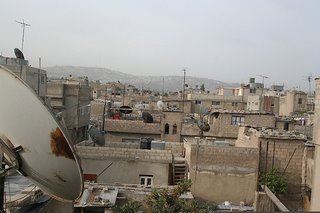
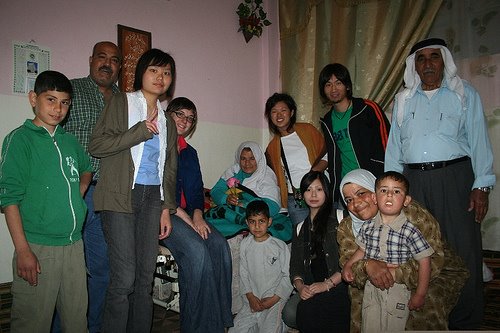
Jordan. I have barely begun to understand the depths of the Palestinian Israeli conflict and I am no position to say who is right or who is wrong. But my time in Jordan has given me first had experience of the life of a Palestinian refugee and I cannot deny that my heart goes out to them. I visited a refugee camp called Baqa'a just outside of Jordan's capital city Amman. The camp began in 1968, after the second wave of refugees fled Palestine in the Israeli-Arab conflict in 1967. About 80 participants from Peace Boat stayed overnight in the camp with host families to experience the daily life of a Palestinian refugee.I felt welcomed and comfortable from the moment I met my family. Five participants and I stayed together in a three story concrete dwelling.
Since I've come back to Japan, I went to see the film Ghada about a Palestinian woman. What the film showed me was that how in my short time in that refugee camp, I had experienced so much. I met with extended family member after family member ( I certainly lost count and how everone was connected rather quickly) The immediate family that I lived with had 13 kids, the youngest being 23 and the oldest 40. With exception to the 23 year old, all of the siblings already had three to five very young kids. They spoke little English and we spoke zilch Arabic and so we mostly played with their kids. They served a huge plate of rice with whole chickens (there must have been a dozen or so chickens) at nine, and we dug in hungry. After dinner, a family friend and the two eldest brothers took us up a mountain to see the nightlights of the camp. We shared a traditional sweet tea with them, customary to be given to guests before saying goodbye, as well as trying the Arabic coffee. We slept in the guest room, the large space next of the bedrooms, on coushons propped agains the wall that we had earlier sat on.
I think I got a real sense of their situation when I met Ismail Suboh while I was walking around the camp. He was an English teacher at one of the schools in the refugee camp and spoke at ease with me. He shared that his daughter had married a man who lived in Palestinian, and left the camp to live with him in Palestine seven yeasr ago. After the seond intifada and border control tightened, he has been unable to visit them. He showed me pictures of his grandchildren, four of them, on his cell phone. That's all he know of them since he has never met them. He wasn't angry or a suicide bomber plotting a revenge, just a concerened grandfather. He told me that he desired a free Palestine, like the one he remembered from his youth, and all he wanted to do was play with his grandkids. You can't deny the pain.
One of the first generation refugees spoke the following day. He said, " If someone came into your home and took it away from you, wouldn't you try to defend it?"
Monday, July 24, 2006
Ky La, Vietnam
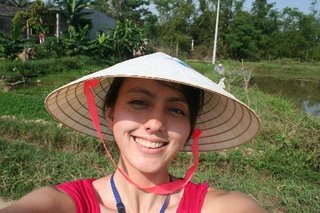
I've dreamt of visiting Vietnam for a long, long time. There is something captivating about it. Perhaps, it's the traditional women's dress the Ao Dai or the tangy and crisp cuisine. Perhaps, it's because the war in Iraq is often compared to the war in Vietnam and I wanted to desperately understand what happened here 30 years ago. I wanted to see what the US had done to Vietnam. If it was possible to still see the traces of the war in the way people lived.
If you have ever seen the Oliver Stone film Heaven and Earth then you've seen these rice paddies before. La Lee Haslip, the woman’s whose life story is depicted in the film, came from this village. Now, living in the US, she has raised money to build health clinics, schools, and vocational training centers for her people. We visited one of the health clinics and met with children suffering from birth defects because of Agent Orange. I have to say it was completely heartbreaking to see these beautiful innocent children who wouldn’t grow up to be healthy adults one day. Their grandparents been affected directly from the toxic sprays of dioxin, yet they had to suffer through the consequences through no fault of their own.
The beauty of the land and the people are undeniable. I didn’t feel any anger or resentment amongst the people. We were welcomed into the homes of the villagers, shared meal with them, played games with their children. We slept on straw mats strewn across the floor, avoided huge crawly insects and sweat through 38 C degree heat. I’d like to one day do a backpacking trip through Vietnam.
Thursday, July 20, 2006
Back from the boat!
Hey I just completed 102 days of sailing around the world. I am back in Tokyo, Japan for now. I will start posting photos here and on fliker in the next couple of days. Come back soon!
love,
Megumi
Tuesday, May 23, 2006
Check out the Peace Boat website
Hey!
Unfortunately, I have no time to update my blog because I am busy busy writing for Peace Boat.
Please go to www.peaceboat.org, and click on Reports from the 53rd Voyage to see what I and Peace Boat are up to.
Hope to see you somewhere around the world soon!
love,
Megumi