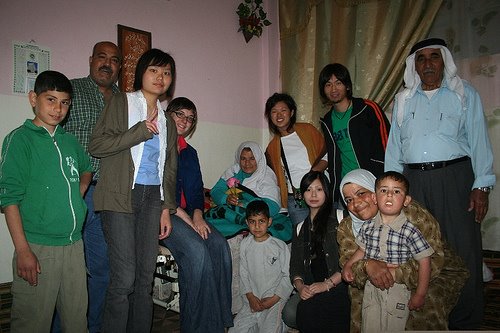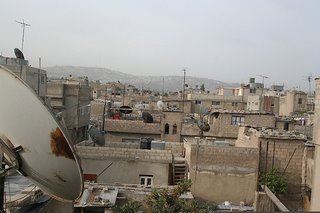
Jordan. I have barely begun to understand the depths of the Palestinian Israeli conflict and I am no position to say who is right or who is wrong. But my time in Jordan has given me first had experience of the life of a Palestinian refugee and I cannot deny that my heart goes out to them. I visited a refugee camp called Baqa'a just outside of Jordan's capital city Amman. The camp began in 1968, after the second wave of refugees fled Palestine in the Israeli-Arab conflict in 1967. About 80 participants from Peace Boat stayed overnight in the camp with host families to experience the daily life of a Palestinian refugee.I felt welcomed and comfortable from the moment I met my family. Five participants and I stayed together in a three story concrete dwelling.
Since I've come back to Japan, I went to see the film Ghada about a Palestinian woman. What the film showed me was that how in my short time in that refugee camp, I had experienced so much. I met with extended family member after family member ( I certainly lost count and how everone was connected rather quickly) The immediate family that I lived with had 13 kids, the youngest being 23 and the oldest 40. With exception to the 23 year old, all of the siblings already had three to five very young kids. They spoke little English and we spoke zilch Arabic and so we mostly played with their kids. They served a huge plate of rice with whole chickens (there must have been a dozen or so chickens) at nine, and we dug in hungry. After dinner, a family friend and the two eldest brothers took us up a mountain to see the nightlights of the camp. We shared a traditional sweet tea with them, customary to be given to guests before saying goodbye, as well as trying the Arabic coffee. We slept in the guest room, the large space next of the bedrooms, on coushons propped agains the wall that we had earlier sat on.
I think I got a real sense of their situation when I met Ismail Suboh while I was walking around the camp. He was an English teacher at one of the schools in the refugee camp and spoke at ease with me. He shared that his daughter had married a man who lived in Palestinian, and left the camp to live with him in Palestine seven yeasr ago. After the seond intifada and border control tightened, he has been unable to visit them. He showed me pictures of his grandchildren, four of them, on his cell phone. That's all he know of them since he has never met them. He wasn't angry or a suicide bomber plotting a revenge, just a concerened grandfather. He told me that he desired a free Palestine, like the one he remembered from his youth, and all he wanted to do was play with his grandkids. You can't deny the pain.
One of the first generation refugees spoke the following day. He said, " If someone came into your home and took it away from you, wouldn't you try to defend it?"
Thursday, August 17, 2006
A refugee camp in Jordan

Monday, July 24, 2006
Ky La, Vietnam
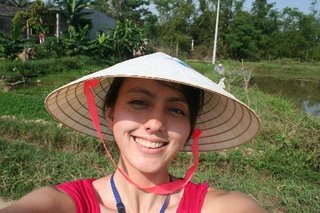
I've dreamt of visiting Vietnam for a long, long time. There is something captivating about it. Perhaps, it's the traditional women's dress the Ao Dai or the tangy and crisp cuisine. Perhaps, it's because the war in Iraq is often compared to the war in Vietnam and I wanted to desperately understand what happened here 30 years ago. I wanted to see what the US had done to Vietnam. If it was possible to still see the traces of the war in the way people lived.
If you have ever seen the Oliver Stone film Heaven and Earth then you've seen these rice paddies before. La Lee Haslip, the woman’s whose life story is depicted in the film, came from this village. Now, living in the US, she has raised money to build health clinics, schools, and vocational training centers for her people. We visited one of the health clinics and met with children suffering from birth defects because of Agent Orange. I have to say it was completely heartbreaking to see these beautiful innocent children who wouldn’t grow up to be healthy adults one day. Their grandparents been affected directly from the toxic sprays of dioxin, yet they had to suffer through the consequences through no fault of their own.
The beauty of the land and the people are undeniable. I didn’t feel any anger or resentment amongst the people. We were welcomed into the homes of the villagers, shared meal with them, played games with their children. We slept on straw mats strewn across the floor, avoided huge crawly insects and sweat through 38 C degree heat. I’d like to one day do a backpacking trip through Vietnam.
Thursday, July 20, 2006
Back from the boat!
Hey I just completed 102 days of sailing around the world. I am back in Tokyo, Japan for now. I will start posting photos here and on fliker in the next couple of days. Come back soon!
love,
Megumi
Tuesday, May 23, 2006
Check out the Peace Boat website
Hey!
Unfortunately, I have no time to update my blog because I am busy busy writing for Peace Boat.
Please go to www.peaceboat.org, and click on Reports from the 53rd Voyage to see what I and Peace Boat are up to.
Hope to see you somewhere around the world soon!
love,
Megumi
Tuesday, March 28, 2006
Setting Sail for Peace
 On April 5th, I will be departing on a three and a half month journey around the world on the Japanese cruise ship Peace Boat. Starting from Yokohama, Japan, the boat will travel east through South East Asia, the Middle East, Europe, North American, the Caribbean, and Central American before returning to Japan in July. I have been invited on-board as the web reporter and will be regularly updating their website (www.peaceboat.org) with photos and reports from the 53rd voyage.
The Peace Boat organization began in the 1980’s when Japanese students became outraged at their government for hiding war crimes from their national textbooks. They then commissioned a boat to travel through Northeast Asia, so that they could gain first hand experience of the autrocities caused by the Japanese government during World War II. Today, Peace Boat is a thousand passenger cruise ship that promotes responsible tourism and educational cultural activities between boat participants and local organizations of the country.
I am looking forward to gaining an in-depth knowledge of the many issues that Peace Boat will address as it sails around the globe. The themes for the 53rd voyage include: recent controversy regarding Article #9 of the Japanese constitution, the challenges of violence in the Middle East, and creating an action plan to live in nuclear free world.
Part of the reason why I actively pursued the web reporter position was because by having to write a regular schedule of articles, I will push myself to reflect and research on the many ways in which activist, scholars, and journalists are working to create peace. Perhaps there will be a documentary film idea among them, but most definitely I will come away with a far greater understanding of peace and conflict resolution and an articulate vocabulary to back me up.
In particular I am excited to visit Da Nang, Vietnam, the largest former US military base during the Vietnam War. This voyage will also be making three stops through the Middle East: to Jordan, Egypt and Libya. In Jordan, I will have the opportunity to visit a Palestinian refugee camp and in Libya I will gain a better understanding of the changing role of women in Islam. I have often been told that my optimism and passion of nonviolence knows nothing of the fundamental fanatics and violence of the Middle East and so it’s so important for me to gain first hand experience in that part of the world. I maybe wrong, but I think my trip there will only put an even more human face to the Arab world.
I really want to make the most of this trip. I hope that the more I experience, the more my heart will grow.
Thursday, March 16, 2006
My short film "March 22" at the Whitney museum

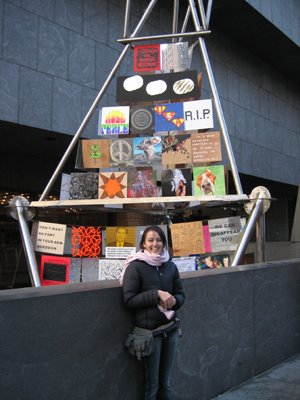
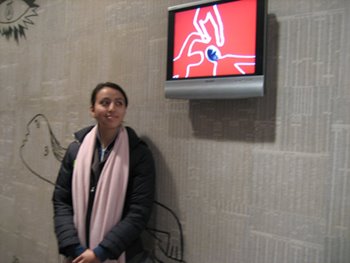 “March 22” is currently a part of a six-hour video compilation created by Deep Dish TV called “Shocking and Awful” that is playing at theWhitney Museum in New York City. www.deepdishtv.org
If you do make it to the Biennial, the video compilation is playing on the bottom floor by the museum store. “Shocking and Awful” is comprised of 12 Half hour segments and “March 22” is included in Segment 4 entitled "The Art of Resistance". If you want to catch it, I would recommend getting to the Whitney within the first hour of opening. I am credited at the end of the segment as well as on the info flyer available next to the screens. The Biennial continues till the end of May.
Wednesday, February 15, 2006
Oscar Nominated Short Docs
It’s Oscar time again! This year I have been making concerted effort to see the films up in the best documentary category. Last Saturday, t I went to a screening of the Oscar nominated short documentaries. Since I’m inclined to create shorter films, I wanted to see the caliber of the nominated shorts.
Three of the four that have been nominated this year are: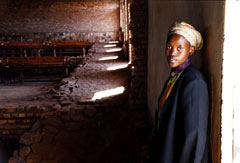 “God Sleep in Rwanda” by Kimberly Acquaro and Stacy Sherman. In a country where 70% of the population is women, this documentary looks at the challenges that five Rwandan women face as they try to rebuild what’s left of their lives in this war torn country. During the 1994 genocide, they witnessed their sons and husbands brutally killed before their own eyes. Some were raped countless times and are now having to deal with gruesome consequences of contracting HIV. This documentary examines the newfound responsibilities, empowerment, dreams that these women are now facing..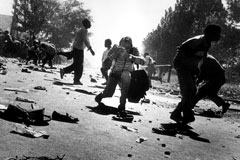
“The Death of Kevin Carter: Casualty of the Bang Bang Club” by Dan Krauss, is a portrait of war photographer Kevin Carter. Interviews with friends, family and colleagues, retell his disturbing experience photo documenting the killings and corpses during the Apartheid in South Africa. His experiences begin to haunt him and eventually lead him to take his own life. 
“The Mushroom Club” by Steven Okazaki, looks at modern-day Japanese society as it honors the 60th anniversary of the Atomic Bomb dropping on Hiroshima. The characters portrayed in the documentary span from some of the oldest survivors to the babies that were affected radioactively while still inside their mother’s womb, now 60 year old adults with disabilities. The documentary begs the question: As the generation of survivors pass away, will the atrocities of one of the greatest crime against humanity be forgotten by the pop-culture obsessed youth?
I find it interesting that as the US lead war in Iraq drags on, three of nominated films touch on the subject of war. (In fact you might say that the fourth film, A Note of Triumph: The Golden Age of Norman Corwin, does as well.) Though none of them are specifically about current US foreign policy, (perhaps an issue that is much to sensitive for the Academy ala Michael Moore’s 2003 speech “Shame on you Mr. President”,) they all show the horrors that we often forget when conflict in that region ceases to dominate news headlines.
Looking at past war genre films, Hollywood mass-produced films that glorified the American hero, played upon the ramped patriotic spirit, and glamorized the latest technological weapon/tactic during World War II. When Vietnam came along, films like Apocalypse Now and Catch-22 reflected the public's disillusionment of war as they revealed the true insanities and horrors of violence.
So what do these three films say about conflict today? They are showing a much larger array of issues; it's not just about the American war or the American experience any longer. It is recognition of conflict on a global scale. We are no longer hearing solely from the solider, now we get to hear the civilian's and journalists' perspectives. There is recognition that war doesn't end when congress calls the troops home, that people spend the rest of their lives rebuilding their homes and hoping for a better future for children. If art does reflect life, as the old adage goes, then I take refuge in the films that are being produced today are reflections of the rising consciousness among us.
Anyways, if you get a chance to go to see a screening, I'd love to hear your thoughts on the films.